Writing · November 16, 2026 · expanded with two more tasks
Three Ways of Seeing, Three Tasks: What Depth and Exact Coordinates Changed
Three RoboDojo tasks, each run three times with the same B601 arms, the same model (gpt-6-astra) and the same layout. Only the spatial information changed: color images only; color and depth; and, on top of that, each object’s exact pose from the simulator. More exact information did not help everywhere. Depth was what got the eggs to the bottom of their wells. Exact coordinates were decisive only on the stacking toy, where every piece has to sit within a millimetre of its peg. For sorting, depth was enough, and which basket the model gave to which arm mattered more than either.
Nine task runs: one per task and setting, one layout per task. Read this as a set of clues about where spatial information helps, not as a measured difference between the settings.
All Nine Runs
| Task | Depth off | Depth + required read | Open coordinates + required read |
|---|---|---|---|
| Egg holdereggs at the bottom | 0 / 431 rounds · 6.43M+ tokens | 3 / 429 rounds · 4.47M tokens | 2 / 440 rounds · 7.99M+ tokens |
| Stacking toypegs complete | 2 / 440 rounds · 13M tokens | 3 / 440 rounds · 10M tokens | 4 / 419 rounds · 3.28M tokens |
| Sortingbaskets right | 2 / 340 rounds · 7.29M tokens | 3 / 325 rounds · 3.64M tokens | 3 / 337 rounds · 6.73M tokens |
Shaded: the best result on that task. Every run kept all three cameras’ color images; “depth” adds depth images and the tools that read them; “open coordinates” adds a tool that asks the simulator for each object’s position, orientation and size (simulation only). Both of the latter groups also had a “required read” rule, explained below. Input tokens include cached tokens.
What Spatial Information Did in Each Task
The three tasks need different things at the moment of release, and that, more than the amount of information, decided which setting won.
- Egg holder: depth mattered, for height. Without depth the model placed the eggs to within about 2 mm sideways but misjudged the well bottoms by 1.5 to 4 cm, and every egg ended on a rim. With depth it read the bottom height and lowered three eggs to the bottom. Exact coordinates added little: the simulator reports each egg, not the centre of each well, so the model went back to depth for the part that mattered, and a collision with the lid cost it 23 rounds.
- Stacking toy: exact coordinates were decisive. Only the open-coordinates run finished, in 19 rounds and with a quarter to a third of the tokens. The difference was not how well it found the pegs (depth found them to within a few millimetres) but that it could read the held piece’s own position while lowering it and correct before letting go. The other two runs released, then found out from the next picture. One caveat: the peg support points the tool returns are the same points RoboDojo’s grader measures against, so this run had the grader’s reference geometry, though not its rules.
- Sorting: depth was enough; coordinates did not help. Depth and open coordinates both sorted everything, but the depth run took 25 rounds and the coordinates run 37. The extra rounds came from the coordinates run’s choice of which basket each kind went to, which forced two handovers across the table. Without depth, the run used up its rounds on two awkward objects.
Across all three:
- Color only was the worst on every task, for a different direct reason each time: height on the egg holder, a few millimetres on the stacking toy, rounds spent on two hard objects in sorting.
- What held the model back was rarely finding things. It was not knowing whether something was in place before letting go, and whether an arm could reach. Exact positions do not solve reach, contact with a wall or lid, or how to grip an object lying against a basket.
- The required-read rule never blocked a move in any of the six runs that had it: the model read before moving on its own. The rule has since been removed from the harness.
- In the stacking and sorting runs, the model’s own account of how each task run ended matched the offline readout every time.
Egg holder: Four eggs into an egg holder
Four eggs in a basket and an egg holder with a lid that starts open. The full goal: all four eggs in the wells and the lid closed. Layout 26. What release needs: height: each egg has to be lowered to the bottom of a well before release.
The Three Runs Side by Side
Select a moment to jump there. All three panes move to the same point in the video.
Depth off
Color images only
Motion ends at 1:24; then the last frame holds.
Depth + required read
Color and depth; a fresh depth read before every move
Motion ends at 1:33; then the last frame holds.
Open coordinates + required read
Color and depth, plus each object's pose from the simulator
Motion ends at 2:21.
How Each Run Ended
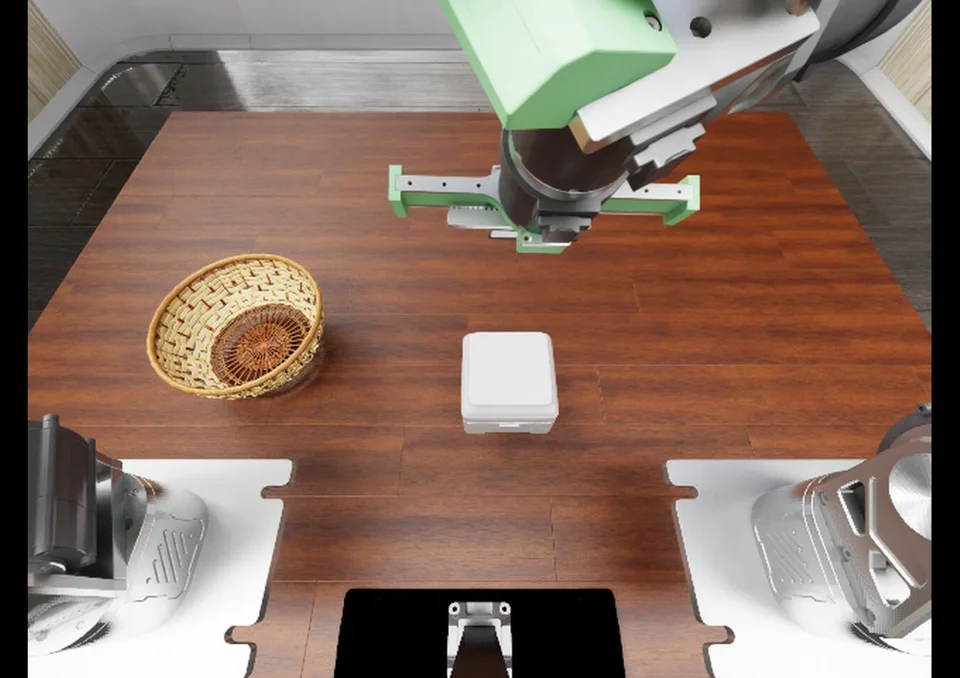
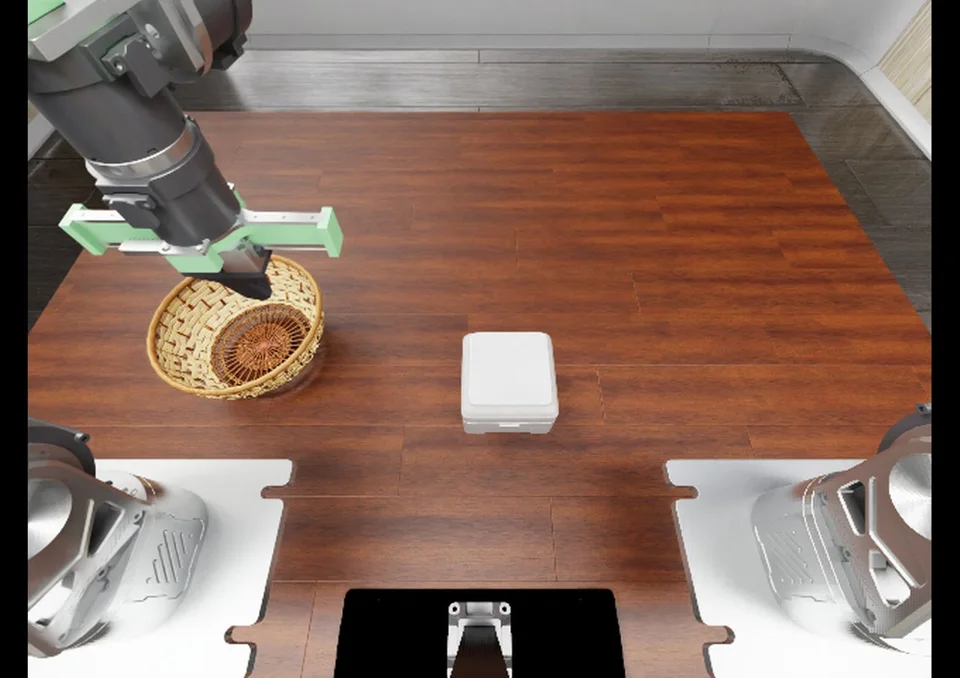
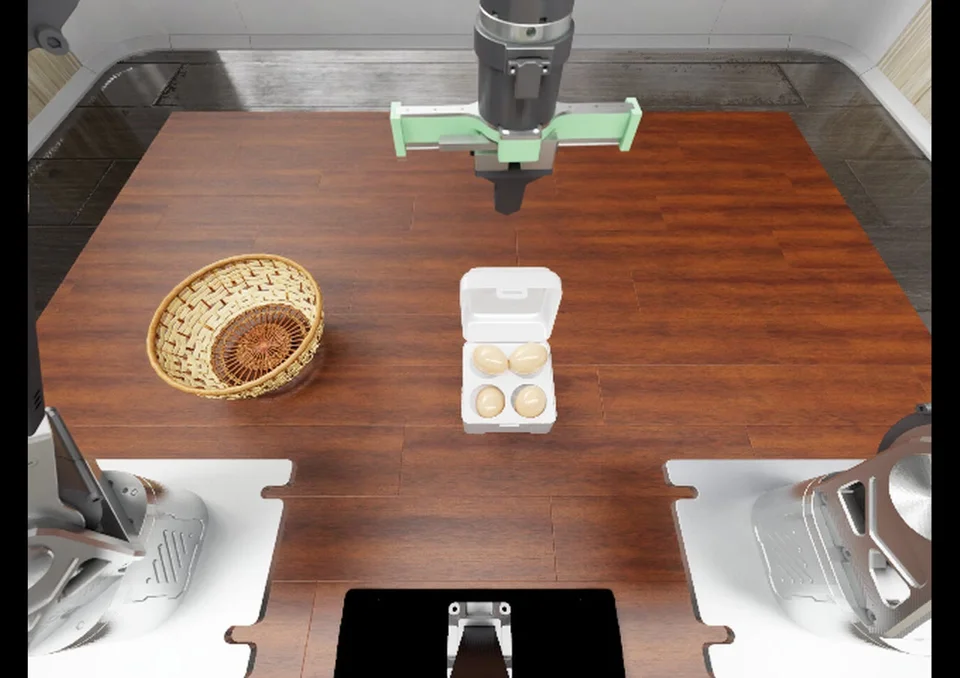
The Numbers
| Depth off | Depth + required read | Open coordinates + required read | |
|---|---|---|---|
| Eggs at the bottom (of 4) | 0 | 3 | 2 |
| RoboDojo graded score | 0 | 40 | 25 |
| Lid | Looks closed | Looks closed | Open |
| How it ended | Declared the task done in its last round | Declared the task done in its last round | All 40 rounds used; no declaration |
| Rounds · requests | 31 · 52 | 29 · 40 | 40 · 69 |
| Input tokens (not cached) | 6.43M+ (0.74M) | 4.47M (0.22M) | 7.99M+ (1.08M) |
| Model thinking · wall clock | 17 min · 49 min | 14 min · 48 min | 48 min · 110 min |
| Moves blocked for a missing read | n/a | 0 | 0 |
A “+” means at least one request returned no token count, so the total is a lower bound. The graded score is RoboDojo’s own partial score for this task; 100 means the full goal was met. Harness 0.4.38. All three task runs were labelled “run error” by this version: the step that writes the run report failed after the task had finished (fixed in 0.4.39). The task runs themselves completed and the offline readout exists.
What Happened in Each Run
Depth off
The three cameras' color images, the camera calibration and the robot's own readings. No depth images, and the tools that read depth are removed.
All four eggs were released above the wells, but none reached the bottom. The model said all four were placed; the offline readout counts zero.
- With color images only, the model placed the wells sideways to within about 2 mm.
- It overestimated the height of the well bottoms by 1.5 to 4 cm, so it opened the gripper too early and the eggs ended up lying on the rims.
- It closed on nothing three times in a row before the second egg, and later closed the gripper to push the lid shut.
Depth + required read
Color and depth images, the camera calibration and the robot's own readings. Before each move, the model must have used a depth-reading tool since the robot last moved; the harness checks only that a read happened, not how it was used.
Three of four eggs reached the bottom of their wells, the best of the three groups, and with the fewest rounds, requests and tokens.
- The depth reads gave the right height for the well bottoms (0.769 m).
- The model used place_and_release to lower each egg to the bottom before opening, so the eggs went in upright.
- The coordinates it read appear unchanged in the targets of its later moves.
- The fourth egg's fingers caught on a well rim; the model lifted 34 mm and released, and that egg stayed 7 mm high.
Open coordinates + required read
Everything the depth group had, plus scene_truth, a tool that asks the simulator for each object's position, orientation and size (open spatial coordinates mode; simulation only). Before each move, the model must have called scene_truth since the robot last moved.
Two eggs reached the bottom. Exact egg positions did not help where it mattered: the simulator does not report where each well is, and the lid was knocked shut while carrying the first egg, which cost 23 rounds.
- The egg positions came straight from the simulator and were exact.
- The simulator does not give the centre of each well, so the model went back to estimating them from depth, about 1.7 cm off.
- In round 8, while carrying the first egg, the arm knocked the standing lid shut. For the next 23 rounds the left hand held the egg up while the right hand tried to reopen the lid; motion planning refused its moves more than fifty times.
- It placed all four eggs in the last rounds (one landed on the divider and was moved into a well), and its program to close the lid was refused as the rounds ran out.
What This Task Suggests
- Height was the problem, not position. Without depth the model placed the wells sideways to within about 2 mm but misjudged their depth by centimetres, and every egg ended on a rim. With depth it read the bottom height correctly and lowered the eggs onto it.
- Exact object coordinates are not the same as knowing the target. The simulator gives each object’s pose, not the centre of each well, so the model went back to depth for the part that mattered. Its extra trouble came from a collision with the lid, which no position query prevents.
- The required read did not get in the way. No move was blocked for a missing read in either group that had the requirement; the model read before moving on its own.
Checked and Not Checked
Checked:
- How each task run ended, the number of rounds, tokens and reads.
- Where each egg ended up and how high, from the simulator's internal state read on the host after the run.
- That the starting layout was still (largest drift 2 mm).
- Where each round falls in the videos, matched by action times to the reply of each round.
Not checked:
- The lid joint readings in the first two groups; “looks closed” is from the images only.
- Which contact knocked the lid shut in the third group (inferred).
- Whether the 1.5 to 1.7 cm error when estimating well centres from depth came from the points the model chose or from the back-projection.
Stacking toy: Ten pieces onto four pegs
Four rings, three rectangles, two stars and one square, to be put onto four pegs. RoboDojo’s grader wants each piece within 1 mm of its peg’s axis. Layout 37. What release needs: millimetre alignment: each piece’s hole has to be over its peg before release.
The Three Runs Side by Side
Select a moment to jump there. All three panes move to the same point in the video.
Depth off
Color images only
Motion ends at 2:43; then the last frame holds.
Depth + required read
Color and depth; a fresh depth read before every move
Motion ends at 2:58.
Open coordinates + required read
Color and depth, plus each object's pose from the simulator
Motion ends at 2:54; then the last frame holds.
How Each Run Ended
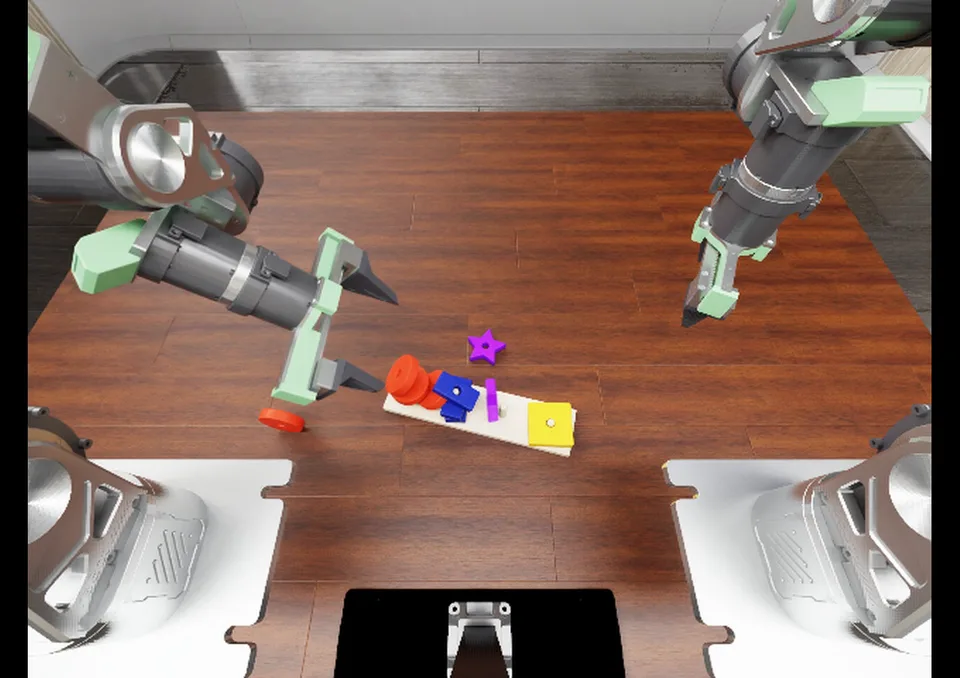
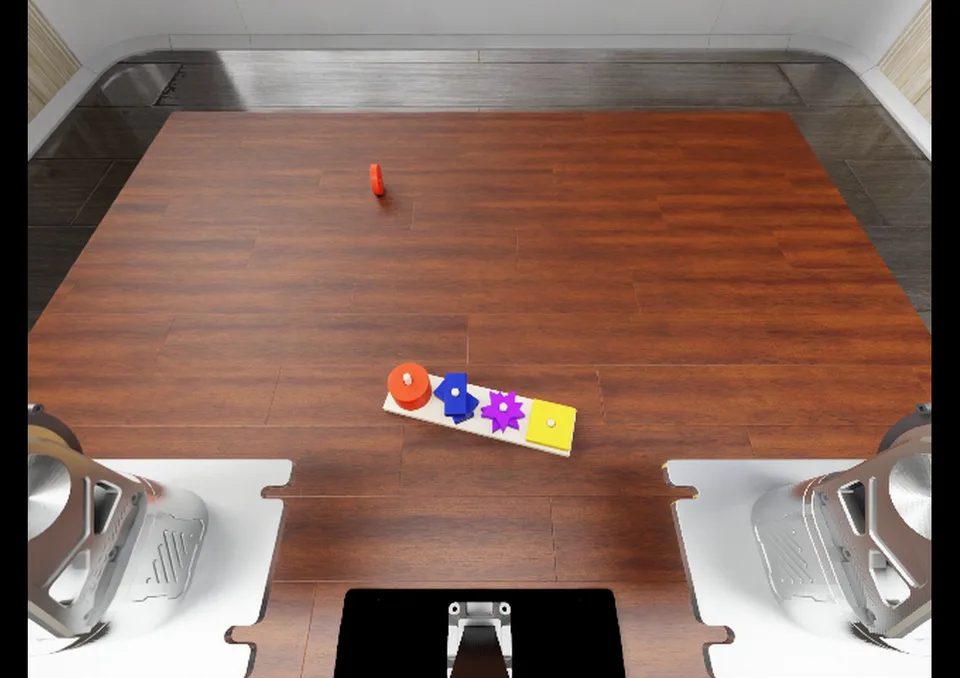
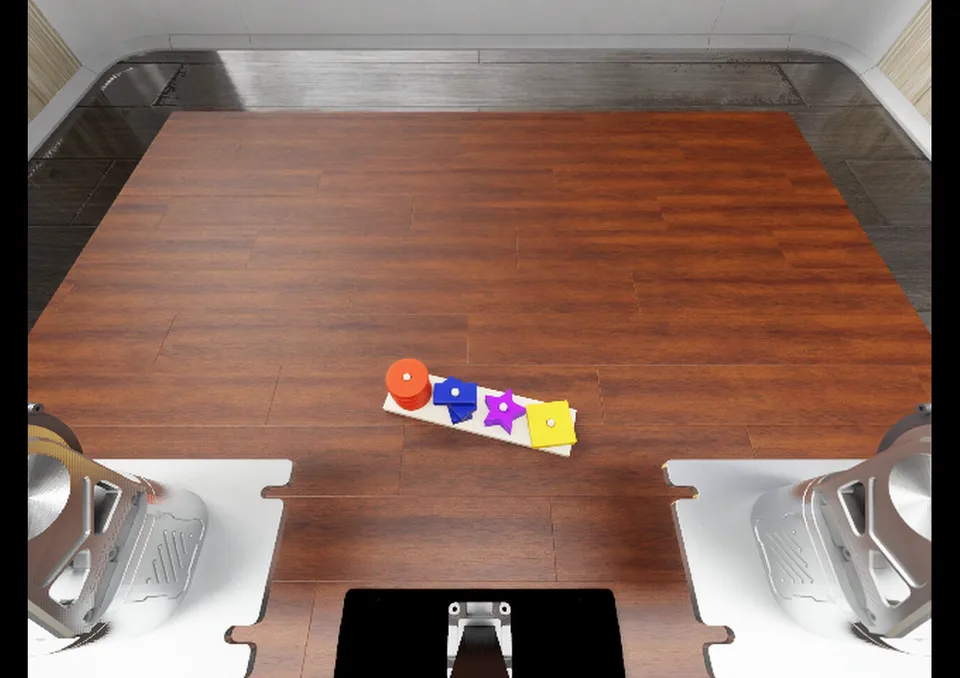
The Numbers
| Depth off | Depth + required read | Open coordinates + required read | |
|---|---|---|---|
| Pegs complete (of 4) | 2 | 3 | 4 |
| RoboDojo graded score | 30 | 60 | 100 |
| How it ended | All 40 rounds used | Declared the task not done (round 39) | Declared the task done (round 18) |
| Rounds · requests | 40 · 94 | 40 · 85 | 19 · 27 |
| Input tokens (not cached) | 13M (0.70M) | 10M (0.95M) | 3.28M (0.60M) |
| Model thinking · wall clock | 38 min · 124 min | 31 min · 126 min | 12 min · 109 min |
| Moves blocked for a missing read | n/a | 0 | 0 |
A “+” means at least one request returned no token count, so the total is a lower bound. The graded score is RoboDojo’s own partial score for this task; 100 means the full goal was met. Harness 0.4.38. All three task runs were labelled “run error” by this version: the step that writes the run report failed after the task had finished (fixed in 0.4.39). The task runs themselves completed and the offline readout exists.
What Happened in Each Run
Depth off
Two of four pegs complete. Every grasp held; the trouble was the last few millimetres over the peg.
- Without depth, the model wrote its own script to triangulate from the camera calibration and several views.
- All 11 grasps held. Of about 10 placements, 5 seated; its peg estimates were off by about 6 mm, and rings tipped over after release.
- It spent about 10 rounds rescuing one ring that had fallen over, and never touched the second star.
Depth + required read
Three of four pegs complete. One ring, released 10.6 mm off the peg, rolled away and decided the run.
- Depth gave the peg positions to within 0.4 to 4.2 mm.
- 13 of 16 grasps held; 9 of 12 placements seated.
- The first ring sat 10.6 mm off-centre in the hand; the model released it without correcting, and it rolled on its edge about 40 cm to the back of the table. It never went back for it.
- About 18 rounds went into fixing pieces that landed crooked and into moves that planning refused.
Open coordinates + required read
All four pegs complete in 19 rounds, the only full success on this task, with a quarter to a third of the other two runs’ input tokens.
- scene_truth gave the support point of each of the four pegs and every piece’s position and orientation.
- All 10 grasps held and all 10 placements seated on the first try.
- Its method: carry the piece over the peg, read the piece’s actual position again, and shift the gripper by the difference between peg and piece; descend at most 18 mm at a time, reading as it goes; release only when the piece is within 2 mm of the peg and at the right height; read once more after release.
- From round 7 on it placed about one piece per round, each written as one program.
What This Task Suggests
- Measuring the piece itself, before letting go, made the difference. Over the peg, the depth run’s pieces were 1.7 to 11 mm off the axis and the open-coordinates run’s 1.8 to 5 mm: not very different. But the open-coordinates run kept reading the piece while lowering it and corrected on the way; the other two released and found out from the next picture, twice with a hand blocking the view.
- Depth precision itself was not the limit. Every piece the depth run did seat ended within 0.3 mm of the axis, the same as the open-coordinates run, because the peg guides the piece in.
- In fairness: in this task the peg support points from the coordinate tool are exactly the points RoboDojo’s grader uses for its 1 mm check. The model was not told the scoring rule, but it had the reference geometry the grader measures against.
Checked and Not Checked
Checked:
- How each task run ended, the number of rounds, requests, tokens and time.
- Where each piece ended up, from the simulator’s internal state read on the host after the run.
- The tool calls and results of every round.
- Whether the model’s own account of each round matched the offline readout; it did in all three.
Not checked:
- The round-by-round analysis was done from the records, not frame by frame against the video.
- “Seated” is our own measure (within 3 mm of the axis, tilted less than 5°), not the grader’s.
Sorting: Seven objects into three baskets
Three toy cars, two watches and two pens, to be sorted by kind into three baskets. All three runs started from the same layout and all three got the categories right. Layout 8. What release needs: coarse placement and reach: the baskets are large; the hard part is which arm can get where.
The Three Runs Side by Side
Select a moment to jump there. All three panes move to the same point in the video.
Depth off
Color images only
Motion ends at 2:27; then the last frame holds.
Depth + required read
Color and depth; a fresh depth read before every move
Motion ends at 2:12; then the last frame holds.
Open coordinates + required read
Color and depth, plus each object's pose from the simulator
Motion ends at 3:08.
How Each Run Ended
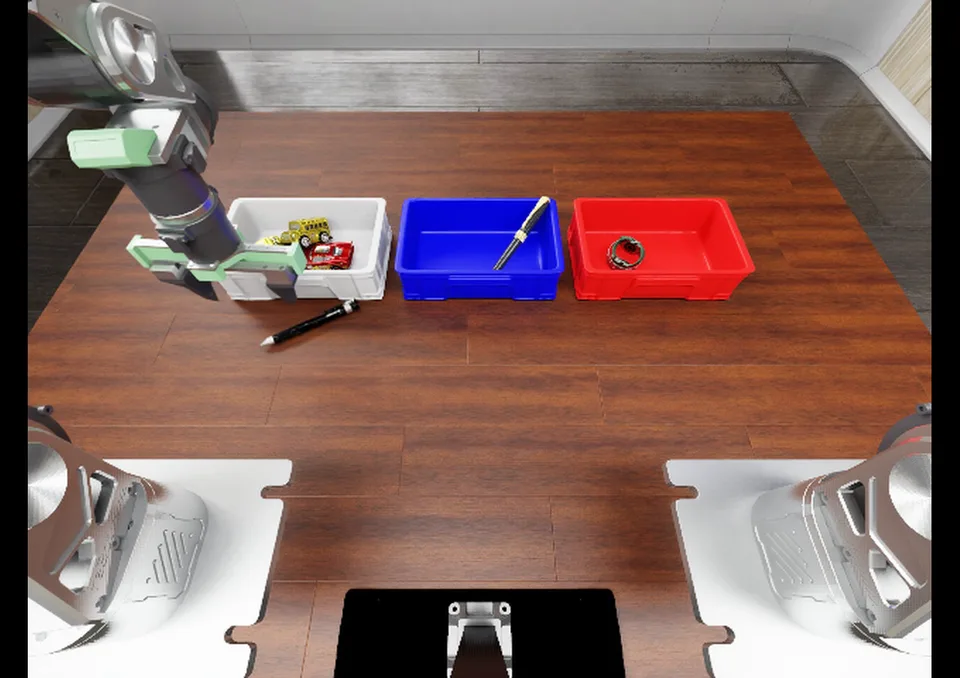
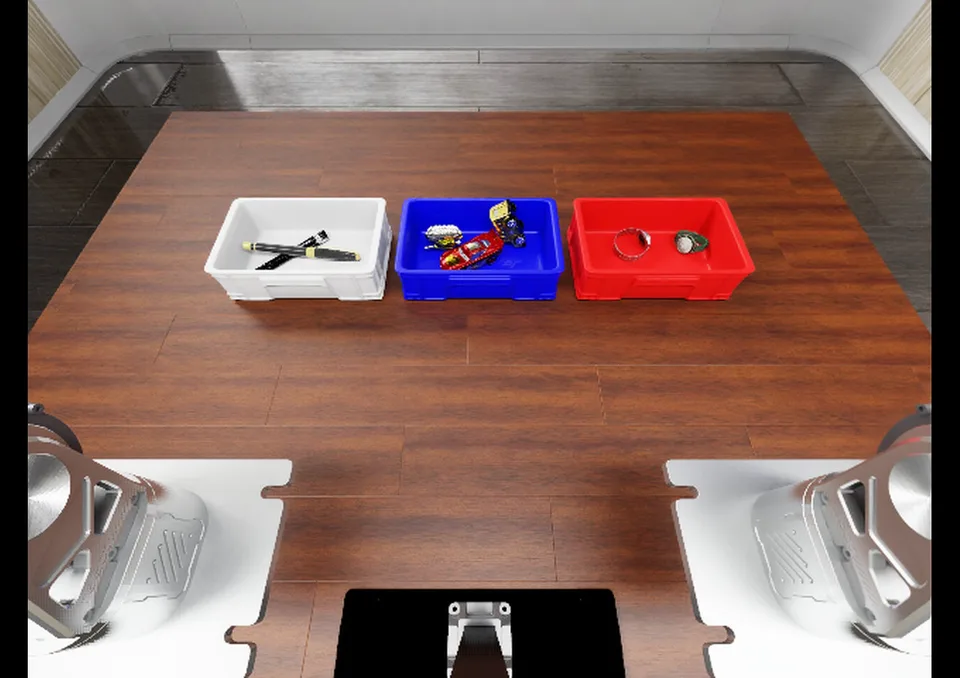
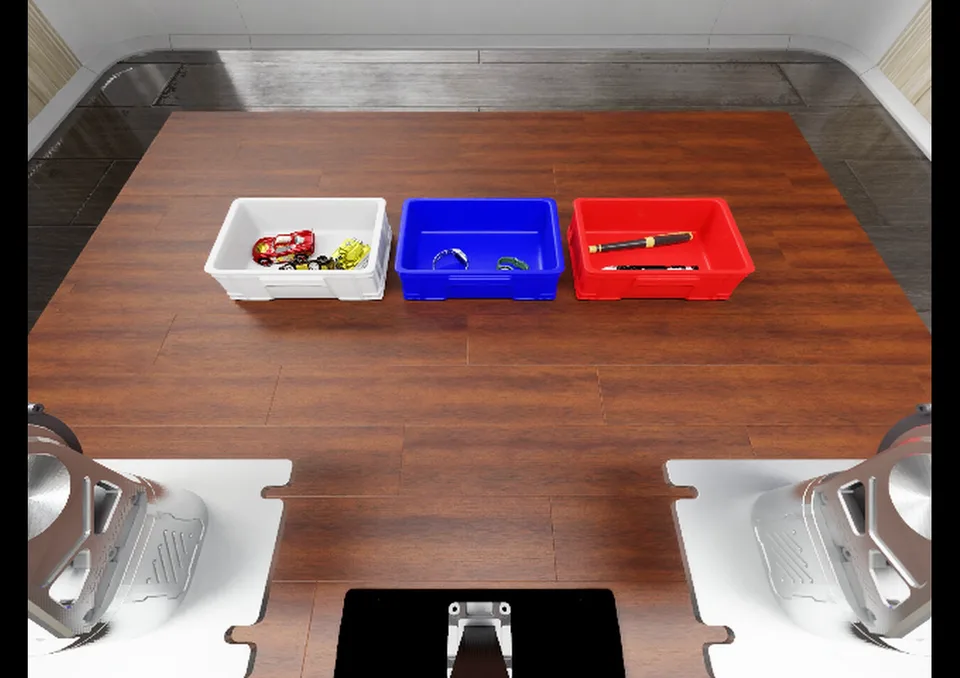
The Numbers
| Depth off | Depth + required read | Open coordinates + required read | |
|---|---|---|---|
| Baskets right (of 3) | 2 | 3 | 3 |
| RoboDojo graded score | 40 | 100 | 100 |
| How it ended | All 40 rounds used | Declared the task done (round 24) | Declared the task done (round 36) |
| Rounds · requests | 40 · 66 | 25 · 32 | 37 · 53 |
| Input tokens (not cached) | 7.29M (0.60M) | 3.64M (0.23M) | 6.73M (0.74M) |
| Model thinking · wall clock | 27 min · 114 min | 13 min · 96 min | 25 min · 133 min |
| Moves blocked for a missing read | n/a | 0 | 0 |
A “+” means at least one request returned no token count, so the total is a lower bound. The graded score is RoboDojo’s own partial score for this task; 100 means the full goal was met. Harness 0.4.39.
What Happened in Each Run
Depth off
Two of three baskets right. The run used up its rounds on two awkward objects.
- It sorted by looking at the images, and located objects from camera rays and an estimated table height.
- Cars went to the left basket, pens to the middle, watches to the right.
- The black pen, lying against the front wall of the left basket, took 9 rounds and was never picked up.
- The rightmost car took 10 rounds: the right hand lifted it but could not carry it across the table, so it set it down mid-table for the left hand. 7 grasps held and 4 closed on nothing.
Depth + required read
All sorted in 25 rounds, the fewest of the three, with about half the tokens.
- It sorted by looking at the images and used depth for the basket floors and object positions.
- In round 3, after planning refused the left arm’s path across the table, it changed its plan: cars to the middle basket, pens to the left.
- That put the rightmost car within the right hand’s reach (3 rounds) and the black pen next to the basket it was already leaning on (3 rounds).
- 7 grasps held and 1 closed on nothing.
Open coordinates + required read
All sorted, in 37 rounds: 12 more than the depth run, with about twice the tokens.
- scene_truth gave each object’s class name (toy_car, watch, pen) and position. The baskets came only as numbers; which class went where was still the model’s choice.
- Cars to the left basket, pens to the right, unchanged throughout.
- The rightmost car took 8 rounds (handed over mid-table). The black pen took 14: misses, pushes and sweeps, and once lifted it still had to be handed over to reach the right basket.
- 9 grasps held and 3 closed on nothing.
What This Task Suggests
- The basket plan, not locating things, set the number of rounds. The same two awkward objects (the rightmost car and the black pen) took the open-coordinates run 22 rounds and the depth run 6. Everything else took about two rounds per object in both.
- The depth run’s plan let both hands reach the middle basket, and put the black pen into the basket it was already leaning against. The open-coordinates run’s plan forced two carries across the table and two handovers.
- That better plan was forced, not chosen. The depth run changed its plan after one move out of reach was refused (our reading of its reports); the open-coordinates run’s first car went in fine, so nothing pushed it to change.
- Exact positions do not settle reach, or how to grip a pen lying against a basket wall.
Checked and Not Checked
Checked:
- How each task run ended, the number of rounds, requests, tokens and time.
- Where each object ended up, from the simulator’s internal state read on the host after the run.
- The tool calls and results of every round.
- Whether the model’s own account of each round matched the offline readout; it did in all three.
Not checked:
- Why the depth run picked up the black pen on its second try. That depth gave a better grasp height is only a guess.
- The round-by-round analysis was done from the records, not frame by frame against the video.
How the Runs Were Set Up
- Tasks: RoboDojo’s egg-holder task (layout 26), stacking-toy task (layout 37) and object-sorting task (layout 8). The model gets only the one-sentence instruction; it is not told how the task is scored.
- Robot and model: two B601-RS arms in Isaac Sim;
gpt-6-astrawith high reasoning effort through the Codex CLI. - Harness: the Zoetic Robotic Harness, version 0.4.38 and 0.4.39. Memory within the task run was on. The segmentation and grasp models were off. Each task run went on until the model declared the task finished or 40 rounds were used, with no step or thinking-time limit. No run met its goal within RoboDojo’s own step limit (egg holder 700, stacking toy 1200, sorting 1100 control steps); the three that did meet it took longer.
- Only one thing differed within a task: the spatial information. “Open coordinates” exists only in simulation.
- The required read: in the depth and open-coordinates groups, a move was refused unless the model had used a depth-reading tool (or, with open coordinates, the coordinate tool) since the robot last moved. The harness checked only that a read happened, not how it was used. It never refused a move in these six runs and was removed from the harness afterwards.
- These nine runs are the first nine of a larger planned batch, which was stopped after them.
Limitations
- One task run per setting and one layout per task. Any of these differences could change on a rerun.
- The side-by-side videos show the top camera only; each run’s page has all three cameras. Videos are 640 × 480 per camera and skip the pauses while the model was thinking.
- Final object positions come from the simulator’s internal state, read on the host after the run; the model never saw them.
- Wall-clock time is mostly not the model: each run’s motion lasted only a few minutes of simulated time, but each task run took between 48 minutes and 2.2 hours of wall clock. Where that time goes has not been measured yet.
- In five of the six stacking and sorting runs, the CLI compacted the conversation once it reached about 250,000 tokens (between rounds 17 and 28); what was lost in that step was not checked.
- Everything here ran in simulation.
Credits
RoboDojo tasks and scenes; Isaac Sim and Isaac Lab; the Zoetic Robotic Harness, forked from ORA (hao-ai-lab/ORA, Apache-2.0); the B601 vendor robot model; gpt-6-astra.