AI Servers
AI Server Retrofit and Deployment
Converting AI servers to heat a home, putting their compute to work, and tuning inference to run fast on them.
An AI server turns nearly all of the electricity it draws into heat. In a data center, that heat is a cost: it has to be removed with fans, chillers and cooling towers, which use even more power. We treat it as a resource instead. We retrofit AI servers so their heat warms a home, and we rent out the compute they produce while they do it. The same kilowatt-hour pays for itself twice: once as heat for the household, and once as compute for our customers.
To make that compute worth renting, we work on the software side too. We tune large language model inference for speed, and we optimize models to run well on older graphics cards, so hardware that would otherwise be retired can keep doing useful work.
Branches
1. Server Conversion
Converting AI servers to work as part of a household heating system.
We take standard AI servers and adapt them for life inside a home. That means redesigning the cooling so heat is captured and delivered to where it is needed, through the hot-water system, underfloor heating or warm air, instead of being blown out of a rack. We handle quieting the hardware, connecting it safely to the home’s electrical supply, and controls that let the server’s output follow the household’s heating demand. Our services cover assessing a home, installing and commissioning the system, and ongoing maintenance and monitoring.
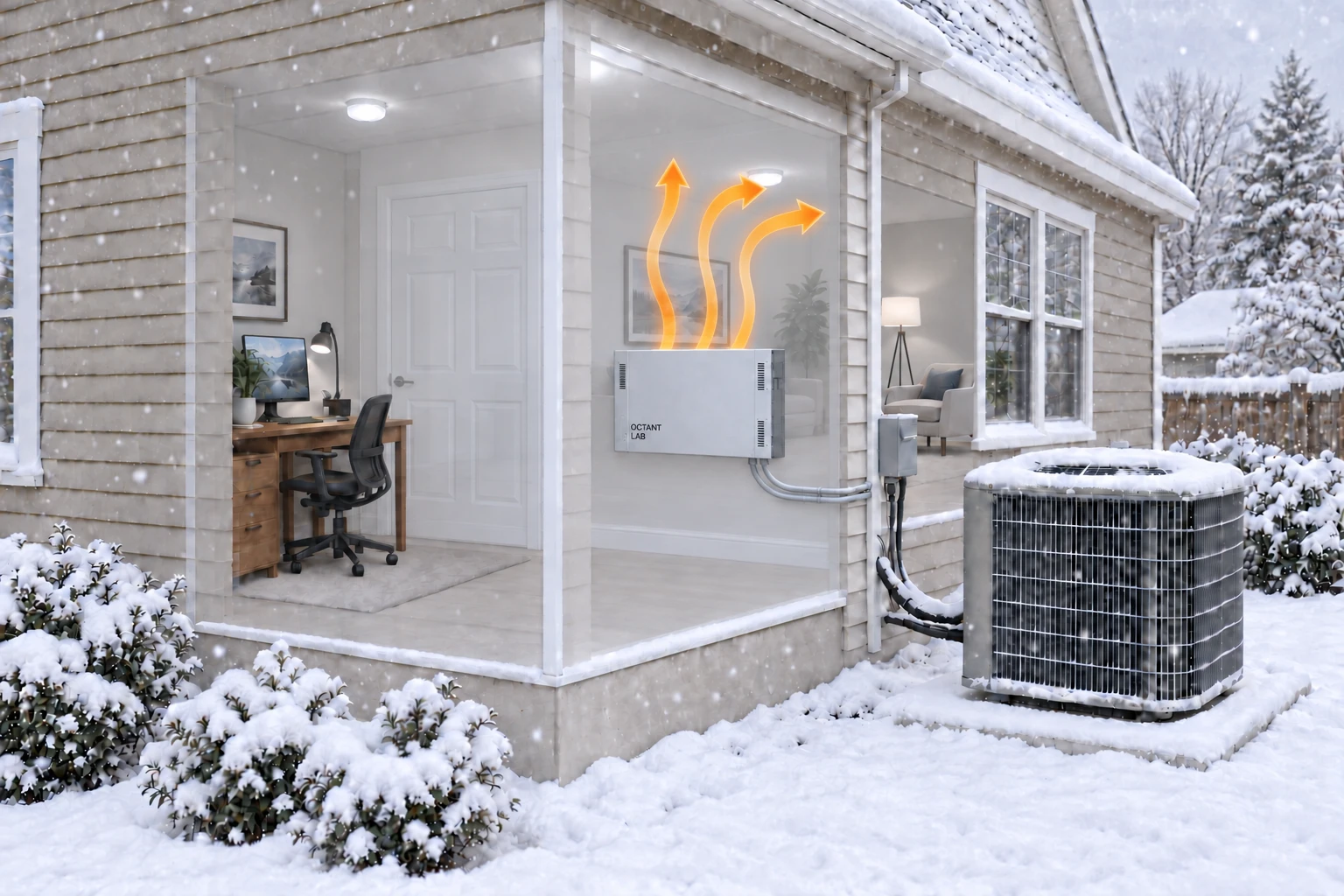
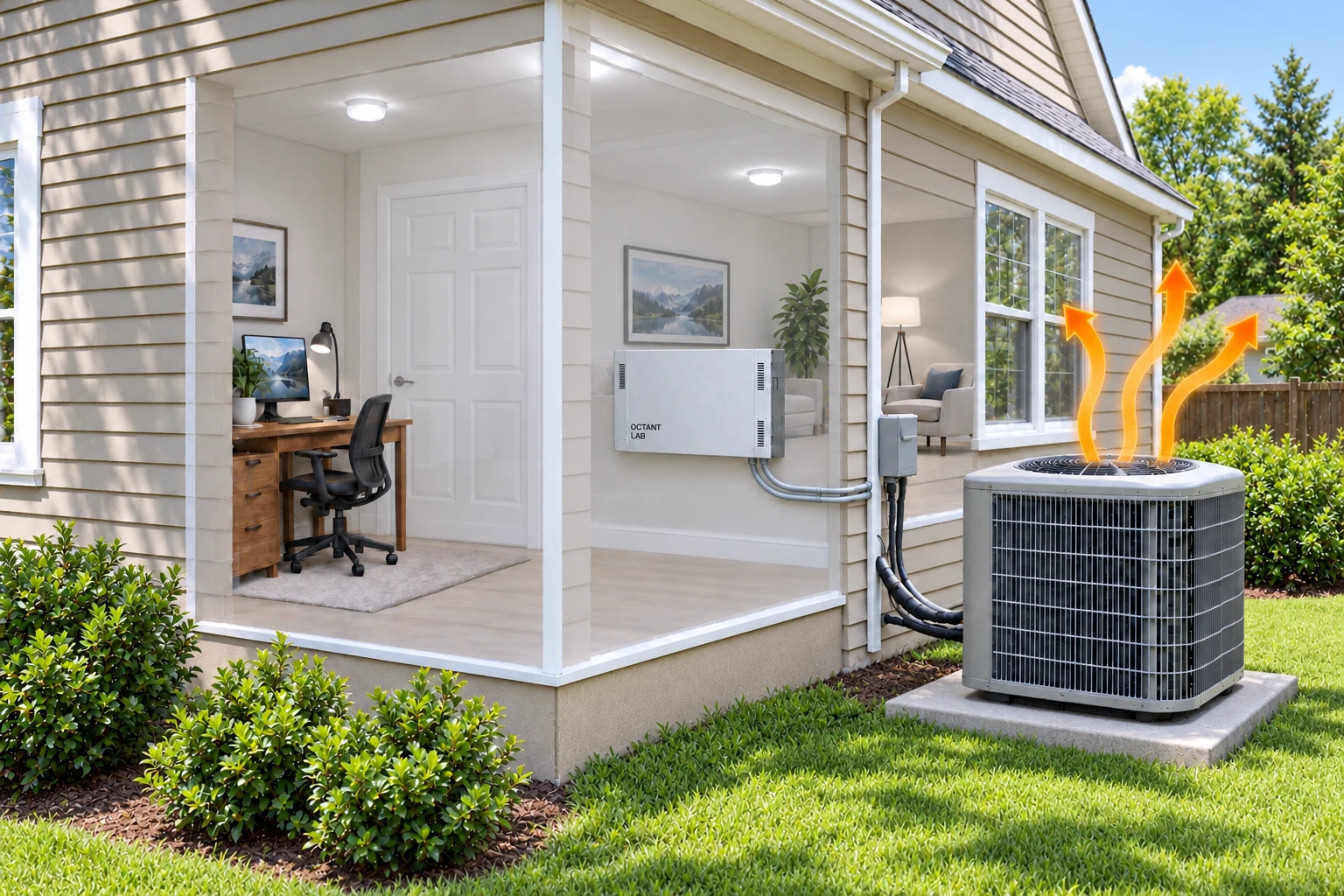 SummerWinter
2. Compute Rental
Renting out the compute the servers provide.
Every converted server is also a working compute node. We pool these machines into a distributed network and rent their capacity to developers, researchers and businesses that need GPU time for inference, fine-tuning or batch jobs. Customers get access to compute at a competitive price, and the revenue offsets the cost of the heat for the homeowner. We manage scheduling, workload isolation, security and uptime across the network, so customers see a reliable service rather than a collection of individual machines.
3. Inference Speed
Raising the inference speed of LLMs.
Faster inference means more useful work from the same hardware and the same electricity. We optimize how large language models run in production, through techniques such as quantization, efficient batching, caching, speculative decoding and kernel-level tuning, to raise throughput and cut latency. We apply this to our own network, and we offer it as a service to teams who want their models to serve more users at lower cost on the hardware they already have.
4. Older GPUs
Optimizing for older graphics cards.
Many capable GPUs are retired early because new models are tuned only for the latest hardware. We adapt and optimize models to run efficiently on previous-generation cards, working around their limits on memory, precision support and bandwidth. A core part of this is heterogeneous inference: instead of leaving the CPU idle and relying on the graphics cards alone, we have the CPU and GPUs share the inference work, which spreads the cost and raises performance by around 40% on the same hardware. This extends the working life of existing equipment, lowers the cost of entry for our customers, and keeps usable hardware out of the waste stream.
Heterogeneous CPU + GPU systems
| Package | CPU | Memory | GPUs |
|---|---|---|---|
| 1 · Entry | Dual Intel Xeon E5-2696 v4 (44 cores / 88 threads) | 128 GB DDR4 ECC RDIMM, 2400 MHz | 2× RTX 2080 Ti + NVLink (44 GB VRAM) |
| 2 · Core | Dual AMD EPYC 7K62 (96 cores / 192 threads) | 128 GB DDR4 ECC RDIMM, 3200 MHz | 2× RTX 2080 Ti + NVLink (44 GB VRAM) |
| 3 · Flagship | Dual AMD EPYC 7K62 (96 cores / 192 threads) | 128 GB DDR4 ECC RDIMM, 3200 MHz | 2× RTX 4090 48 GB modified edition (96 GB VRAM) |
Other GPU options
| Package | GPUs |
|---|---|
| 1 | 6× Tesla V100 32 GB |
| 2 | 5× AMD Instinct MI210 64 GB |
| 3 | 8× Tesla V100 32 GB (OEM) |
| 4 | 4× NVIDIA 170HX (64 GB, PCIe Gen2 x16 modified) |